#MathsConf18

Yesterday (March 9th 2019) I attended #MathsConf18 – my fourth Maths Conference! This time around, I wasn’t presenting which meant I could attend five workshops, alongside mathematical speed-dating and making hexaflexagons in the Tweet Up at lunchtime. As ever, the whole day was packed with content and I came away (as always) more determined to improve my teaching and with strategies of how to do so! In this post, I will share some initial reflections on the workshops I attended.

Workshop 1

My first workshop was on Managing Workload from @MrEdWatson – a Head of Maths from Bristol. While I would generally describe my workload as being ‘manageable’, this is something that I have to work hard to manage and typically involves working longer term-time hours than is probably optimal. As such, I was keen to leave with some strategies to put into place to help here.

Ed encouraged us to think about a typical teaching day, and place the tasks that we complete into the below table (taken from the work of Stephen Covey).

covey-time-management-matrix.001.001

During a typical day, I would describe most of the tasks that I complete as being both urgent and important (quadrant 1). This, though, often leads to a feeling of ‘fire-fighting’ and higher stress levels about the tasks to be completed – it is better for productivity if we are working in quadrant 2 (important, not urgent) as much as possible.

Ed also spoke about how it is really easy to spend a lot of our time being busy, but not productive. This really resonated with me! It is quite easy to make it to the end of a long day at work and still feel as though you have failed to accomplish what you set out to do. A possible strategy to help rectify this is to write a ‘to-do’ list of tasks for the next day the next evening; while this sounds obvious, it isn’t something I do routinely which means I end up completing tasks ‘as and when’, rather than scheduling my time most effectively. We also looked at how all tasks expand to fill the time you have available – if you have 3 hours to plan a lesson, it will take you 3 hours. If you have 10 minutes, it will take 10 minutes. Again, this is something I want to work on! While I am certainly not a perfectionist, I am definitely guilty of spending hours on tasks which will not have a significant impact on student learning, simply because I have the time available. Ed really stressed that time is precious – to be as impactful as possible, we need to be ruthless with how we allocate our time.

There was so much food for thought in this session alongside some potentially controversial points raised (textbooks – yes or no?) and Ed was a fantastic speaker – I came away with things that I want to try immediately; we will see how that goes!

Workshop 2

I finally managed to attend a workshop by Naveen Rizvi (@naveenfrizvi) – after the past two conferences where I was presenting at the same time as her, it was such a wonderful opportunity to see what she’s been working on!

The focus of Naveen’s presentation was on atomisation (that is, breaking down a task/skill/procedure into all of its sub-skills/tasks), with a specific focus on teaching angles in parallel lines. I’ve been working hard over the last year to break down content as much as possible when I am teaching, but I always find this much harder when trying to teach geometrical concepts, so I was really keen to find out how Naveen had done this.

One thing Naveen said was that most typical exercises for students to practice angles in parallel lines were either really easy, or really hard, without much for the ‘in-between’ stage. This is something that I have definitely found in my experience – most students can find pairs of alternate, corresponding or co-interior angles where that is the only skill required, but then struggle to access multi-step ‘exam-style’ questions. Naveen took us through a series of examples/questions that she had developed. It was fascinating to see how by focusing on changing just one thing (for example, including an extra transversal) each time, her students would be able to be successful at the most challenging mathematics. Throughout her presentation, this emphasis that Naveen placed on ‘success for all’ was apparent – she stressed how by spending time on planning carefully chosen examples and scripting explanations, it meant that all her students would achieve success, rather than just a handful of ‘high-attainers’.

The other thing Naveen said which resonated hugely for me was that by ‘breaking down a topic into its sub-tasks, a teacher can identify 100% of the domain of knowledge’. When teaching any topic, it is easy enough to look at a scheme of work, teach what you believe to be the required content, and yet later testing reveals that your students have significant gaps. For example, when teaching ‘angles in parallel lines’ previously, I may well have forgotten to include any instruction related to isosceles triangles and angles in parallel lines, or parallel lines involving multiple transversals. I almost certainly would have failed to include multiple orientations. The amount of thought that Naveen puts into how a topic should be taught to ensure everything followed in a logical order and didn’t lead to further misconceptions was remarkable. I’m not sure when I’m next teaching this topic but I already cannot wait!

Workshop 3

For workshop 3, I attended Andrew Taylor’s (@AQAMaths) session on old exam questions and papers. Having only sat my Mathematics GCSE in 2009 and having started teaching in 2015, I wasn’t that aware of how the qualification had changed over time, so I was excited to find out.

Andrew started with a couple of non-calculator arithmetic questions for us to try (I cannot remember at all which year these were taken from!) – it was very apparent how the level of challenge for arithmetic in 2019 is certainly not what it once was. Several people commented that even their highest attaining year 11 students would struggle with what was required.

Andrew shared a number of examples from previous Mathematics exam papers with us; it was so interesting to see how certain types of question haven’t changed much at all in the last fifty years whereas others would be virtually unrecognisable (my favourite was was the one featuring Welsh towns and trigonometry!) to a student sitting the paper today. I also had no idea how much choice there used to be in Mathematics papers/qualifications. The University of London’s O Level in 1957 featured three compulsory 2.5 hour long papers on Arithmetic and Trigonometry, Algebra and Geometry, alongside an optional paper (which could be on the History of Mathematics!). It certainly put into perspective the three ninety minute papers that our students sit today.

Again – this was a really fascinating session! Andrew gave us an old O Level paper which I cannot wait to show my students next week.

Workshop 4

After lunch and the mathematical tweet-up, I attended Jo Morgan’s (@mathsjem) session on Topics In Depth: Unit Conversions. Now, I cannot pretend to be particularly thrilled when I see that I have unit conversions coming up on a Scheme of Work, so I was hopeful that I would come away feeling at least slightly more inspired.

Jo started with showing us the KS2 National Curriculum requirements for working with measures and different unit conversions – she made the point that many of our Year 7s will be fairly adept at converting between different metric measures (and solving problems involving this skill) but that this often seems to be lost somewhere between Year 7 and Year 11. This is something that has definitely been true in my experience; I have taught numerous Year 11 students who cannot remember the number of centimetres in a metre or grams in a kilogram.

Jo shared with us some of her research about the etymology of unit prefixes (kilo-, deci- centi-, milli-, etc.). While this is something that I do mention to my classes, I think I tend to skip over it in favour of practice. I hadn’t known that bigger units (kilo, mega, giga etc.) all come from Greek, whereas smaller units (deci, centi, milli etc.) all come from Latin – while not necessarily ‘useful’ knowledge, definitely something interesting that I want to share with classes in future!

Jo shared with us a number of different ways that we can teach students to convert between different units; conversations with the people I was sat with suggested that we generally favour a ratio table or a common sense/reasoning approach. I’ve recently loved using proportionality diagrams for all sorts of ratio/proportion problems, so I was really pleased to see that this excellent post by Don Steward was mentioned.

The most fascinating part was Jo teaching us a new method for unit conversions; that of ‘last unit standing’. I have still not decided how I feel about this method or if it is something I will ever use in the classroom – but it was such a delight to see something completely new! Here is how it would work for a relatively simple problem:

Convert 250mm into metres.
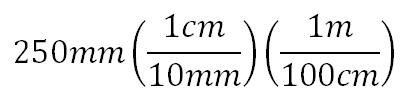
conversion1conversion2

It also works for compound measures! For more on this, I would recommend look at Jo’s slides which are available here. I cannot stress enough – even if I make the decision to never use this with students, I love knowing that it exists and that it gives me another tool at my disposal.

Workshop 5

For my final workshop of the day, I went to see Kris Boulton (@kris_boulton) presenting on solving equations. It is always a real pleasure to see Kris present because it is so clear how much thought has gone into everything that he shares. Having spent a week at King Solomon Academy when Kris was teaching there in 2016, I know first-hand how really carefully sequenced instruction leads to remarkable outcomes, so I am always keen to learn more about how he approaches his planning.

Kris shared with us 17 processes that students need to be fluent with to be successful at solving one-step equations. Something I really noticed from this was how much important Kris would place on what the equals sign means, alongside looking at statements of the form:

7+3=6+4

before beginning the process of solving. While I have been developing this over the last few years, I am definitely guilty of choosing:

x+4=9

 as the starting point, when to do so is presuming an overwhelming amount of prior knowledge that my students wouldn’t have access to.

The method Kris shared with us for solving equations is 4 steps:

  • Decision-make
  • Break
  • Repair
  • Simplify

Usefully, by identifying these four steps as exactly what needs to be done to solve any linear equations, we don’t have to expect students to complete all four steps from the very beginning. For example, it may well be beneficial to spend a period of time on just the ‘break’ stage, before moving to looking at ‘repairing’. I was also particularly taken by the use of the words ‘break’ and ‘repair’ – typically, I have stressed ‘having to do the same to both sides’ when teaching equations, but I am not sure the extent to which students actually understand what I mean or why they are doing it. There was something intuitive about how Kris introduced breaking and repairing, which I am really keen to try out.

Now, it is obvious that to teaching solving equations to a class using this method is going to take far more time than I would have spent on this previously. However – whenever I have taught this previously (to any class at any stage of their mathematical journey), they have had to be retaught various parts at various points. Ultimately, it will be better to invest more time from the beginning than to have to reteach and fix and correct many many times over. I left with so much to think about and ideas to try out.

Finally: I cannot thank Mark (@EmathsUK) and the whole La Salle Education (@lasalleed) team enough for all they do for Maths teachers alongside raising money for Macmillan Cancer Support. The whole #MathsConf movement has been such a massive support for me in terms of making connections with other teachers and improving my own practice. If you’ve not attended before, make sure you book for Sheffield in June – even if you are nervous about coming alone (as I was, the first time!) you will meet the best people and have the best CPD. See you there!

Reflections on Dividing Fractions

Since I first started teaching, I’ve always been somewhat unsure of how to approach the topic of dividing fractions by fractions. While the procedure is relatively easy to perform, giving students the opportunity to see why and how it works always proved much more challenging. This week, I taught this in my favourite way yet, which I will share in this post.


Attempt 1

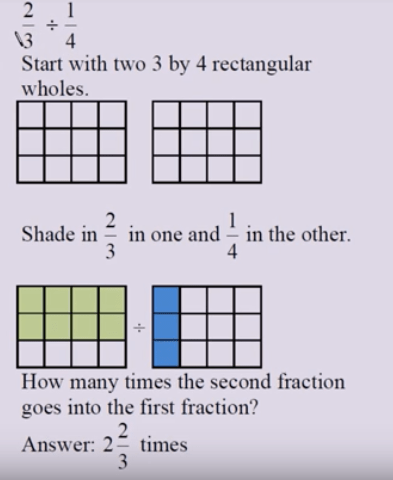
The very first time I taught this, I was keen to avoid sharing any form of ‘keep, flip, change’ mnemonic or ‘just flip the second fraction upside down and multiply’, because I wanted my students to understand what they were doing beyond following a procedure. As such, I did a bit of research (back before I’d joined Twitter!) and decided to present students to the topic by using models such as these. After all, I reasoned, it is always best to start with a pictorial representation.

division

One of the biggest issues is that I was asking far too much of the students I was teaching: I had incorrectly believed that the simple presentation of a pictorial method would enable the students to see the underlying mathematical structures, but without excellent teacher questioning and exposition, this is unlikely to happen. I (at this point in my career) certainly wasn’t able to make effective use of this model. As such, I think the main outcome of this particular lesson was that students had simply acquired more procedural knowledge – but this procedure had even more opportunities for students to make errors than the standard ‘keep, flip, change’ algorithm.

Moreover, while it worked quite nicely for small fractions, and is excellent for exploring what is happening when fractions with the same denominator are divided, it became quickly convoluted when dealing with mixed numbers and less straightforward problems. Again, this isn’t necessarily an issue with the model itself, but I had failed to plan for an ‘exit strategy’ (that is – a way for students, over time, to be able to answer similar questions without the need for the model). I want to be clear that the reason this sequence of lessons was not as successful as I had hoped was more due to a lack of pedagogical knowledge on my part, rather than an inherent problems with the model, but the consequence of this experience was that I completely changed my approach when I next taught division of fractions.

Attempt 2

The second time I taught division of fractions by fractions, I had made up my mind that I wasn’t going to spend much time on why the procedure that I taught worked. My reasoning was that my first attempt had been unsuccessful, and I was currently exploring the idea that it might be better to teach the how before the why. The rationale was that if students become procedurally fluent with how to divide fractions, and through practice, are able to automatise the procedure, then this success would enable me to return to why it worked afterwards. I’d also been considering the idea that asking students to understand why is often more cognitively demanding than understanding how, so I made the decision to begin with how.

The lesson in question ran relatively successfully: I modelled through some examples, and then students did some practice in a variety of ways. Obviously, multiple students did want to know why this procedure was working, but I promised them that we would return to this later. In reality, though, this never really happened. After that initial lesson, students stopped asking why.

Moreover, when we returned to dividing fractions in subsequent lessons/homeworks/assessments, it became clear that the majority of my class were failing to retain this procedure. I think there are multiple reasons why this was happening, but I think that one important reason is that students spent most of the initial lesson on dividing fractions not thinking. They were answering plenty of questions successfully, but then again, they only needed to think ‘well, I flip this upside down’ – the multiplication of the numerators and the denominators was something that students in that class were already confident with. As such, once they’d completed the first few questions, the rest of the lesson was simply more mindless practice, as although the numbers became more difficult to manipulate, they didn’t have to think about the important key features of dividing fractions by fractions. As before, this attempt had not been successful as it needed to be.


Attempt 3

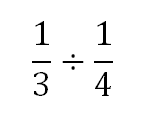
Next time round, I decided to approach the idea from ‘pattern spotting’ and allowing students to hopefully deduce the need to ‘flip the second fraction upside down’. We started with this question:

fractions 1

All students were quite happy with the idea that this would be 2, once it had been shown diagrammatically. We moved onto related questions:

fractions 2

Again, this all seemed to be fairly straightforward. We then discussed this question: ‘if 4 divided by ½ is 8, what other ways can you state the relationship between 4 and 8?’ From this, I tried to draw out the necessary truth that dividing by ½ must be the same as multiplying by 2, and that dividing by 2/3 must be the same as multiplying by 3, and so on. Some students (those of higher prior attainment) grasped this idea really quickly, which was excellent. For other students (particularly those of lower prior attainment), this explanation was evidently not complete. While they were confident with how they could divide whole numbers by unit fractions using simple diagrams, they really struggled with making the link to how this process related to questions such as:

fractions 3

They could replicate the changing of ¼ to 4, and the division sign to a multiplication sign, but I still think something was missing.


More Recently

In this last week, I taught division of fractions to my Year 7 class. For some context, my Year 7 class are completely mixed in terms of their prior attainment. In class, we had already looked at addition and subtraction of fractions, multiplication, simplifying and converting between mixed numbers and improper fraction. I am continually astonished at their mathematical capabilities and in awe of their primary school teachers, as the vast majority of this class are remarkably fluent with the manipulation of fractions.

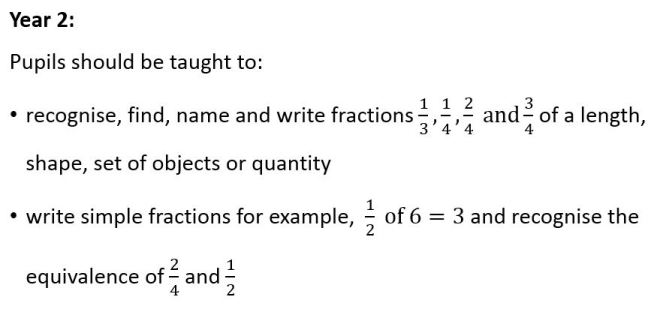
I had a quick look through the Key Stage 2 National Curriculum (always my first point for teaching anything to Year 7 these days!), and noted that between Years 3 and 6 they would have covered:

  • Recognising unit fractions as a division of a quantity
  • Solving problems involving fractions to divide quantities, including non-unit fractions where the answer is a whole number
  • Dividing proper fractions by whole numbers

This gave me a really useful starting point.

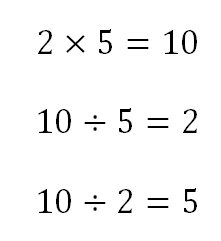
I began the lesson by giving them these three related statements:

fractions 4

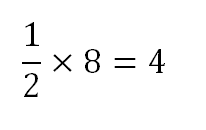
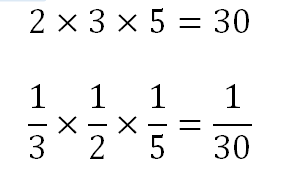
I then gave them a sequence of multiplication statements, and asked them to write any related division statements. While the first couple of questions involved the use of only positive integers, I also included questions such as:

fractions 5

(This was particularly interesting, as one of my highest attaining students then asked: ‘miss, I’ve written 4 divided by 1/2 = 8, but wouldn’t 4 divided by 1/2 be 2?). I also included questions such as:

fractions 6


This was a nice introduction – the last couple, in particular, caused all sorts of questions and to be asked and conjectures to be made. After this, I brought the class back together, and we looked at questions such as:

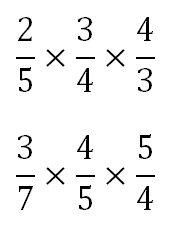
fractions 7

After multiplying and simplifying, they noticed that when you have:

fractions 8

Or questions in that form, the answer must be 1. This was a lot of fun: there was a noticeable ‘buzz’ in the room, and at this point, I introduced them to the word reciprocal. I would never have bothered sharing this with a Year 7 class previously, as I mistakenly believed it would have overcomplicated things, and after all, they would go on to meet this terminology later. This was a mistake – it is so important that our students have the opportunity to express things in precise mathematical language as early as possible, and they were so excited about this new word to add to their collection. After this, we did some practice of finding reciprocals.

I brought the class back together again, and explained we were going to look at how this all fitted together. Returning to the earlier question of:

fractions 9

I challenged them to write a related division statement. After a few moments of thinking, pupils shared the following ideas:

fractions 10

At this stage, there were quite a few murmurs around the room: some students were beginning to spot the relationship between division by 4/3 and multiplication by ¾, and so on. Obviously, some students were not yet there, but through some discussion and questioning, we drew out the implication that division by a fraction must necessarily be the same as multiplying by its reciprocal. We went through some examples together, students did some more practice, and every single student left being able to confidently use the word reciprocal, with most being able to articulate the relationship between division and multiplication of a reciprocal.


Obviously, I don’t think this lesson was perfect! I’ve still got a lot of learning to do about how best to bring in different representations in order to support all students with their understanding, and I still don’t know how this approach will prove to be in the long-term. Nonetheless, it was one of my favourite lessons I’ve taught this year, and I think it was definitely the best I’ve ever taught this topic. I’m going to continue to reflect on how best to improve this, and I’m definitely going to continue to develop my use of precise mathematical language with all classes and all topics.

Tackling Re-Teaching and Overcoming Familiarity

On October 13th 2018, I presented a workshop at #MathsConf17 entitled ‘Tackling Re-Teaching and Overcoming Familiarity’. In this post, I will discuss the ideas that I shared on the day itself!

So, I began by looking at the mistakes I had made when re-teaching topics in the past.

These, I think, are the following:

  1. I hadn’t assessed the prior knowledge of the students.
  2. I was teaching topics as though they were seeing them for the first time.
  3. I failed to consider the thoughts/feelings/perceptions that my students experienced, when they encountered topics with which they were already familiar.


Problem 1: I hadn’t assessed the prior knowledge of the students.

I always used to think that when I did make the decision to re-teach a topic, I did so based on prior assessment data. Specifically, if the majority of a class that I taught underperformed on a particular question in an exam, then I would reteach that particular topic.

I shared the example of how my Foundation Year 11 class had all answered part (b) of the following question incorrectly in their first GCSE Mock Exam, and explained how I had re-taught adding and subtracting fractions in light of this.

mc1.JPG

However, there is a huge problem associated with assessing based solely on high-stakes, summative assessments. David Putwain’s study in 2007 focused on KS4 students in the UK and the effect that test-anxiety can have on performance; he (unsurprisingly) found that students who are most affected by exam-anxiety are the students who are most likely to under-perform, which is due to the amount of space in working memory that the ‘worry’ is occupying. Even more interestingly, mock exams are often likely to cause even more significant anxiety than ‘the real thing’, as students are often acutely aware of how close (and yet how far!) they are to sitting the high stakes GCSE.

However, even if we discount exam-anxiety as causing my students to under-perform on this particular question, the fact still remains that one question, one time, doesn’t tell us very much (and this is why I think it is worth being wary of exactly what we can infer from Question Level Analyses).

For a student to be really successful in adding fractions, I would suggest they need to be secure in the following pre-requisites:

  • Adding fractions with the same denominator
  • Identify fractions as the proportion shaded
  • Being able to place fractions on a number line (they need a sense of how big 2/7 is compared to 8/9).
  • Identify the LCM (or even just a common multiple) of two numbers
  • Simplifying fractions

There’s probably far more than these, but ultimately, if a pupil isn’t secure in these fundamentals, then trying to take them through the whole procedure of adding and subtracting fractions is quite likely to lead to them coming unstuck. I couldn’t have told you which of these skills my class could or could not do – I had just grouped all these errors into ‘can’t add fractions’ and tried to re-teach accordingly.

My approach now is to always begin with some multiple choice diagnostic questions. Sometimes, depending on the class (or topic), I will do a printed paper copy pre-test; sometimes I’ll get pupils to answer on mini-whiteboards, and sometimes I’ll just ask them to show me 1, 2, 3 or 4 fingers depending on which option they’d like to vote for. I always source these from www.diagnosticquestions.com, because the quality of questions is really high, and importantly, it should be impossible for students to guess incorrectly while still holding onto a misconception.

However, this is only the very first step on the journey! After all, what you are most likely to find within a typical class is that some pupils know certain prerequisites, some don’t. This process of planning, therefore, can become extremely difficult and can quickly result in students working on different activities as you attempt to plan for all of their starting points. I’ll come back to this!


Problem 2: I was teaching topics as though they were seeing them for the first time.

When I began my lesson with my Year 11 class on Adding and Subtracting Fractions, I started as though they were seeing this for the very first time. During the teacher exposition section, I may well have uttered these words: ‘oh, I know you’ll have done adding and subtracting fractions before, but…’ and then continued with the explanations I had planned. The problem was that that sentence had gone unfinished, and I have no doubt that some of my students finished it for themselves:

‘oh, I know you’ll have done this before, but you couldn’t do it’

‘I know you’ve done this before, but you’ve forgotten’.

‘I know you’ve done this before, but you failed.’

This, in itself, is incredibly demoralising. While I would never say any of the above to a class, and while I would always attempt to be positive and supportive and encouraging (‘come on, we’ll get there! You can do this!’), my students had probably heard those statements of encouragement already.

Now, as you’ll be aware, students have met fractions quite a few times before. If we take a look now at the National Curriculum expectations for ‘Fractions’ for Key Stage 1 and Key Stage 2:

mcyear1mcyear2mcyear3mcyear4mcyear5mcyear6

By Year 3, pupils are expected to be able to order unit fractions! In year 5, pupils are first taught how to add fractions with different denominators. By year 6, pupils are expected to add and subtract mixed numbers. We can be quite clear that by Year 11, pupils have studied fractions quite a lot.

This, I suppose, leads to the question: well, why are re-teaching so much? And the answer, I think, is obvious: because students forget! This, however, is so far from an ideal situation. It is such a shame and such a waste of so much of their time at school that they are being re-taught relatively basic mathematics again and again and again. My Year 11 class were absolutely not atypical, and so I think it is so important that we focus on strategies to avoid us being stuck in a cycle of re-teaching.

To avoid having to re-teach, I think we need to do the following:

  • Cover things in a good level of depth from the beginning.

This is obviously key – if pupils are exposed to procedure after procedure after procedure in a superficial way, then we can expect them to forget completely, or to remember misconceptions. I’m certainly not an expert at this (although I attended excellent sessions by @MrMattock and @berniewestacott on the day, which has given me plenty of food for thought!) but the more that we can do to look in depth at concepts and procedures, and the more we can use multiple representations to strengthen pupils understanding, the better. Moreover, don’t move on if your class are not ready to!

This is easier said than done – I am fully aware of time pressures in certain schools being to cover a lot of content, but the more you can do to slow down to ensure success first time round, the better.

  • Ensure topics are revisited regularly – in starter activities/homework/low-stakes quizzes

This again, seems obvious – don’t teach them adding fractions, leave it for a year, and then be surprised that they’ve fallen back to ‘add the tops, add the bottoms’ again! You need to give them the opportunity to practice it – put some questions in with starter activities and in their homework. Interleave it when looking at other topics – the most straightforward example is always related to perimeter, but what about when teaching the order of operations? What about collecting like terms?

Finally, it’s really important that we take time to look at our schemes of work and the sequencing of content. The nature of our subject means that revisiting old content is inevitable – it would be ludicrous to claim that we can teach EVERYTHING to do with fractions in one go, as fractions is effectively an unlimited concept – there is always something more you can do with it. I’m certainly not an expert at the best ways to structure a scheme of work, but I think a greater awareness of what students have done before/will be going on to do can only help if we are to avoid the constantly re-teaching problem.

However, even when we are not having to reteach something that should be Year 5 or Year 6 knowledge, we are always going to re-cover things – specifically, you will need to extend students’ knowledge on a topic they have encountered before, which leads onto problem 3.


Problem 3: I failed to consider the thoughts/feelings/perceptions that my students experienced, when they encountered topics with which they were already familiar.

It is worth, at this point, drawing a distinction between the Year 11 Foundation class previously mentioned and the Year 10 top set that I was teaching at the same time. The reason for this is that I want to demonstrate that re-teaching and familiarity and how we approach this is something that is relevant to students of all different levels of prior attainment – it may be easy to see how what I have spoken about so far as something that affects only middle and bottom sets, but this is not always the case.

I was having to teach this Year 10 class the GCSE Higher topic of ‘Ratio and Proportion’; while I was not directly re-teaching simplifying into ratios or sharing into a ratio, they were certainly familiar with the fundamental ideas. Now, when I was teaching my Year 10s ratio, or my Year 11s fractions, I would regularly hear comments along the following lines (importantly, these comments would be consistent, despite the differing prior attainment of both classes and despite the re-teaching/revisiting distinction):

  • ‘We’ve done this before – this is easy’.
  • ‘I can’t do this, I always get this wrong’.
  • ‘We’ve done this before, I’m really good at this’
  • ‘I’ve never seen this before in my life’.


Now, within a typical class, you will most likely have a mixture of these types of students at any one point. The question is, then: why are they thinking like this and how can we best respond?

Perhaps even more than that, you might be thinking ‘well, why does this even matter?’

To be honest, for the first few years of my teaching I’d have been thinking very much this. For some context, I was one of those people who liked learning Maths at school – and I would imagine that this is the same for most people reading this blog! Maths was always something that I was quite good at; I didn’t have to work that hard, and so I didn’t really mind revisiting topics. Now, I’ve always been empathetic to my students who don’t feel the same way as I did, and so I am (hopefully) supportive and encouraging but equally, when it came down to it, it didn’t matter that how they felt about it; what mattered was whether they could do it or not. However, I think if we ignore the way in which our students feel when they encounter a familiar topic, we are unlikely to get them to make as much progress as is possible.

At this, point, then, it is worth making a distinction between prior knowledge and prior experience. Prior knowledge is that which we can assess relatively easily; prior experience cannot be. Of course, the longer you teach a class for, the more of an insight you have into this. With the classes that I’ve taught for more than one consecutive year, I’ve got much more of an awareness of how easy or difficult they found a topic the first time round, and I can make an attempt to realistically gauge how they might feel when they see solving equations or standard form for the second or third time. For a class that you’re teaching for the first year, this is going to be tricky! I’m not sure I’ve particularly found a way around this yet, but I think it is so important to be aware.

For the student who is thinking: ‘I always get this wrong, I can’t do this’, or has any similarly negative mind-set, you need to ensure they achieve success quickly. We need to be aware that motivation doesn’t necessarily lead to success, but success frequently leads to motivation. No matter how positive you are feeling and no matter how encouraging you try to be, it will not matter if they still cannot do the necessary skill.

For the student who is thinking, ‘we’ve done this before, I’m good at this’ or ‘this is easy’ – you need to be careful. I think this is where things get really interesting. The reason that this is so interesting is that often the students who proclaimed to find something easy, or became offended or patronised when faced with familiar content were not students who could demonstrate they had the necessary knowledge! They would tell me ‘oh, I know how to do this’, and mean it, but I would know that they couldn’t – i.e. they’d answered the prerequisites incorrectly, and when talking to those students one-on-one, it became really clear they had either misconceptions or insufficient knowledge. For example, I taught an amazingly bright Year 10 student, and the moment I’d set the class off on some ratio practice, she’d proclaim that ‘she got it’ and she didn’t need to do any more. When speaking to her, she simply couldn’t do the more challenging questions, but felt that she did. With my Year 11 class, I had one student who was adamant that he did not need to practise any more adding fractions, as he’d understood and he wanted to move on. Now we all know that practise is necessary for students to retain anything long term – we know that ‘practice makes permanent’ – but if I couldn’t get them to practise, then we were back to the beginning.

So, I was really fascinated by what was going on: why did I teach so many students who were adamant that they’d ‘got it’ when I could tell this wasn’t the case? Again, went away, did some thinking, did some reading, and came across the following that really helped me to make some sense of what was going on.

Daniel Willingham identifies that there are two main ways in which we determine if we know something – familiarity and partial access.

He states that “familiarity is the knowledge of having seen or otherwise experienced some stimulus before, but having little information associated with it in your memory.” Now, familiarity is generally quite a good guide for us to check if we know something! However, this would mean we would never make a mistake of when we decide if we know something, and of course, we sometimes do. One study that was done into this involved giving participants a variety of word pairs to study (e.g. golf and par), before participants answered some trivia questions. Where the words in the questions were familiar to the participants, they were significantly more likely to say that they ‘knew’ the answer, even if this was not the case. Where the words in the questions were not familiar, participants could assess their own knowledge more accurately.

The implications for this in the classroom seem fairly obvious: we are constantly providing pupils with cues – whether in the form of key words, lesson titles, images, the things we say. These are helping to familiarise our pupils with the content we need to cover – but this familiarity can also be leading them to a false sense of knowing, and I think this needs to be taken seriously in our planning.

The other way in which we determine if we know something is by ‘partial access’, which Willingham defines as: “the knowledge that an individual has of either a component of the target material or information closely related to the target material.” Again, partial access is a fairly good guide to knowing things in most circumstances! If you asked me a question about late 00s reality TV, for example, I would immediately feel like I knew it, due to a high level of knowledge of this particular topic – regardless of whether I’d ever learnt that given fact before. The example Willingham cites is of ‘Who composed the ballet for Swan Lake?’ Regardless of whether you know this or not, the fact that you can probably name several composers means you may feel quite certain that you do know it. If instead, I asked, ‘who choreographed the ballet Swan Lake?’, you’d probably feel much less certain and be more likely to say you don’t know, because you are less likely to have access to a list of choreographers. Again, this has important implications for us in the classroom.

Our students, all the time, have lots of partial access to lots of different areas of mathematics; some much more than others! Nuthall’s claim is that our students, at any one time, know between 40 and 50% of what we are trying to teach them. This is what makes our job incredibly difficult – not only will our students actually have different knowledge to each other, but they will almost certainly have different (and often incorrect) perceptions about the knowledge that they have.


In terms of what this means for us in the classroom, then:

We need to ensure we are providing students with the opportunity to practise, but this practice needs to feel and look different. If the practice that we give our students is very much the same as the practice they have experienced before, we are likely to be inducing that feeling of familiarity, which can be so damaging. For the confident student, they are likely to switch off (‘I can do that – I know how to do this – I’ve done it before’). For your less confident student, their experience is very likely, at least on some level, to be ‘well, I’ve failed at this before – I’ll probably fail again’.

Before discussing possible resources, it is definitely worth acknowledging that this will be context dependent. If, for example, you use similar tasks with classes in Year 7, Year 8, Year 9 and Year 10, then the possible impact is likely to be lost when using with Year 11, and they will experience that same false sense of knowing which comes from familiarity.

This is one task (taken from http://www.openmiddle.com/adding-fractions-7/), which I have since used when re-teaching.

mcopen middle.JPG

Now, when I first came across this problem, I thought it had answered all of my problems! All students, having been re-taught adding fractions, would be able to practise, but there would be a wider sense of purpose.

When I used it, however, it wasn’t quite that simple. Students, and this is, perhaps, more of a reflection on the nature of my classroom environment than of the task itself, wanted to find the right answer. Some felt that it would be impossible, and gave up – when I suggested they just plugged some numbers in to see where this would get them, it became clear they didn’t see much point. Some other students went about reasoning about what the denominators must be, but didn’t actually get that much practise done, and so failed to achieve the outcome that I was hoping for. I think this is because this task was missing something that is key for revisiting topics: pupils need to feel successful early on. If not, it is all too easy for students to give up.

Now, this is something I’ve really struggled with! With more ‘open problems’ compared to more routine practice, the success often comes later. At least; the students have a perception that it will come later, or more frequently, won’t come at all, no matter how much we promote the very true narrative that making mistakes and learning from them is excellent and valuable. Having done some thinking, I’m not convinced that is a problem with the design of the task itself, but more in terms of how it can be implemented and used.

Two things that I now think about more carefully when using similar problems:

How can I provide a way in such that all pupils can access the task?

How can I model what success here would look like?

In terms of answering that first point: here is a task that I have used with classes since. This is what I initially give out:

mcvenn1 Now, the first time I tried using a Venn diagram, it did not go well. I think I had been too vague about what was expected of them, and so they didn’t really know what I was getting them to aim at – my suggestions of ‘make up your own example!’ was not received well, as they had such a focus on being ‘right’ or ‘wrong’ that the message was lost. As such, I adapted this task in the smallest way: I gave them three questions to place into the Venn diagram.

mcvenn2

Without meaning to be too dramatic about this, it was a revelation. All of a sudden there was significantly more of a focus – they were challenged to complete it as they understood what being successful looked like – once those three had been placed, the challenge of ‘can you create your own example?’ followed much more naturally. From that, it was easy enough to progress by considering three way Venn Diagrams with impossible regions – what makes it impossible? How do you know?

In conclusion, then: whenever you are teaching a topic to a class who are already familiar with all or some of the content: consider what their perceptions might be, and consider task designs which prevents students from feeling ‘familiar’ with what is being covered.